
Why Most People Get Retirement Planning Wrong
Meet Ramesh, a 42-year-old software engineer in Pune earning ₹18 lakh per year. He has a decent lifestyle, a home loan, two kids in school, and a vague plan to “start saving seriously once the loan is paid off.” Sound familiar?
Or consider Priya, 28, a marketing professional in Delhi who opened a PPF account last year but isn’t sure if it’s enough. She maxes out her EPF contributions through her employer but has no idea how much she’ll actually need when she retires.
Both Ramesh and Priya represent the majority of working professionals: people who know they should be saving for retirement but feel overwhelmed, confused, or convinced they’ll figure it out “later.”
The brutal truth? Later is expensive. Every year you delay retirement savings costs you far more than just one year of contributions — it costs you a decade or more of compounded growth on that money. This guide will show you exactly what to do, step by step, with real numbers and real scenarios.
Step 1: Know Your Retirement Number
Before you can plan, you need a target. Most people skip this step entirely, which is why they feel lost.
The 25x Rule (and Why It Works)
The most widely used rule of thumb in retirement planning is the 25x Rule: multiply your expected annual retirement expenses by 25, and that’s your retirement corpus target. This is derived from the 4% Safe Withdrawal Rate — the idea that you can withdraw 4% of your portfolio per year without running out of money over a 30-year retirement.
Real-Life Example:
Suppose you currently spend ₹60,000 per month (₹7.2 lakh per year). In retirement, assuming your lifestyle stays similar (no home loan, kids are independent), let’s estimate you’ll need ₹50,000/month = ₹6 lakh/year.
Retirement corpus needed = ₹6 lakh × 25 = ₹1.5 crore
But wait — inflation matters. If you’re 30 years away from retirement and inflation averages 6%, that ₹6 lakh annual expense in today’s money becomes roughly ₹34 lakh/year by the time you retire. Now your corpus target becomes ₹34 lakh × 25 = ₹8.5 crore.
That sounds enormous. But here’s the key insight: you don’t need to save ₹8.5 crore from scratch. You need to invest enough regularly that compounding does most of the heavy lifting.
Accounting for Healthcare and Longevity
People consistently underestimate two things: how long they’ll live and how much healthcare will cost. In India, average life expectancy is rising steadily. If you retire at 60, you could live another 25–30 years. Add to this the fact that healthcare inflation in India runs at 10–14% annually — far higher than general inflation.
Practical Action: Add a separate “healthcare buffer” of at least 15–20% on top of your calculated corpus. If your target is ₹8.5 crore, plan for ₹10 crore.
Step 2: Start Early — The Math Is Merciless
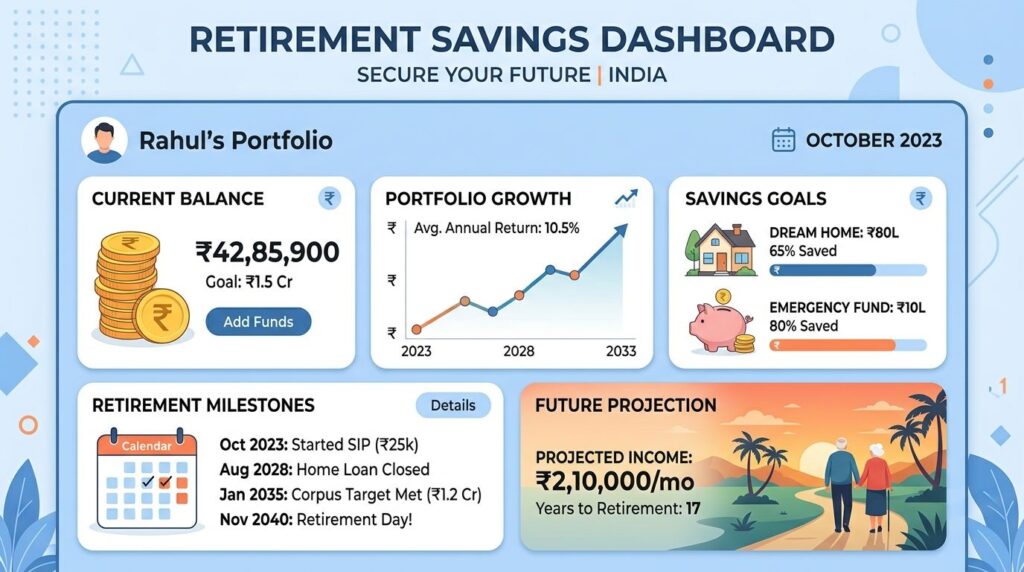
This is not a cliché. The difference between starting at 25 versus 35 is staggering.
The Power of Compounding in Real Numbers
Let’s say both Ananya (starts at 25) and Vikram (starts at 35) want to retire at 60. Both earn a 12% annual return (achievable with equity mutual funds over long periods).
Ananya: Invests ₹10,000/month for 35 years → Total invested: ₹42 lakh → Corpus at 60: approximately ₹6.5 crore
Vikram: Invests ₹10,000/month for 25 years → Total invested: ₹30 lakh → Corpus at 60: approximately ₹1.9 crore
To match Ananya’s corpus, Vikram would need to invest roughly ₹34,000/month — more than three times as much — just because he started 10 years late.
The extra 10 years Ananya had weren’t just 10 more years of contributions. They were 10 more years of compounding on everything she’d already accumulated. This is the miracle — and the tyranny — of compounding.
Practical Action: If you haven’t started, start today. Even ₹2,000 a month in an index fund at age 22 is worth more at 60 than ₹10,000 a month starting at 35.
Step 3: Build Your Retirement Portfolio — The Right Asset Mix
Most people either put everything in “safe” instruments like FDs or PPF, or they go all-in on equity and panic during market crashes. Neither extreme serves you well.
The Core Asset Allocation Framework
A good retirement portfolio typically balances three buckets:
Bucket 1 — Growth (Equity) This is your wealth-building engine. Over 15–30 year horizons, equity consistently outperforms every other asset class. Index funds tracking the Nifty 50 or a diversified equity mutual fund (flexi-cap or large-cap) are the bedrock.
Real-life application: If you’re 30 years old, allocate 70–80% of your retirement savings to equity. Yes, the market will crash. Yes, it will recover — and the long history of markets shows that patient investors are rewarded.
Bucket 2 — Stability (Debt & Fixed Income) This includes EPF, PPF, NPS (debt allocation), and government bonds. These don’t beat inflation by much, but they provide predictability and act as a buffer when equity markets are volatile.
Real-life application: A 30-year-old might keep 15–20% here. As you approach retirement (say, within 10 years), shift more money into this bucket to protect gains.
Bucket 3 — Inflation Hedge (Real Assets / Gold) Gold, REITs, or sovereign gold bonds (SGBs) help hedge against inflation and currency risk. Keep this at 5–10% of your portfolio. Don’t over-allocate — gold doesn’t generate income or grow businesses; it just preserves purchasing power.
The Age-Based Rule of Thumb
A classic guideline: “100 minus your age” = your equity allocation percentage.
So at 30, hold 70% equity. At 50, hold 50% equity. At 65, hold 35% equity.
This is a starting point, not a law. Your personal risk tolerance, income stability, and financial goals should all influence the final allocation. Someone with a government pension and stable income can afford to hold more equity even in retirement.
Step 4: The Essential Instruments — What to Actually Use
Here’s where we get concrete about where to park your retirement savings in the Indian context.
EPF (Employees’ Provident Fund) — Your Non-Negotiable Foundation
If you’re salaried, you’re already contributing 12% of your basic salary to EPF, and your employer matches it. EPF currently offers around 8.1–8.5% interest, tax-free on withdrawal after 5 years. This is remarkable — a guaranteed, inflation-beating, tax-free return.
Practical tip: Don’t withdraw your EPF when you change jobs. This is the single most common mistake salaried employees make. Transfer it via the EPFO portal instead. Withdrawing even once resets the 5-year clock and creates a taxable event.
PPF (Public Provident Fund) — The Long-Game Compounder
PPF offers about 7.1% interest (revised quarterly), is completely tax-free (EEE status — exempt at investment, growth, and withdrawal), and has a 15-year lock-in that can be extended in 5-year blocks.
Real-life strategy: Open a PPF account the moment you start earning. Invest ₹1.5 lakh per year (the maximum allowed) and let it compound. Over 30 years at 7%, ₹1.5 lakh/year becomes approximately ₹1.5 crore — with zero tax.
NPS (National Pension System) — The Underrated Powerhouse
NPS is one of the most tax-efficient retirement instruments available and still underutilised by most Indians. Here’s why it matters:
- Additional tax deduction of ₹50,000 under Section 80CCD(1B), over and above the ₹1.5 lakh 80C limit
- You choose your asset allocation (up to 75% equity for those under 50)
- Very low fund management charges (0.09% — among the lowest in the world)
- Corpus grows with market-linked returns
Real-life example: If you’re in the 30% tax bracket, contributing ₹50,000 additionally to NPS saves you ₹15,000 in taxes immediately. That’s a guaranteed 30% instant return before the investment even begins to grow.
The downside: 40% of the corpus must be used to buy an annuity at retirement, which currently gives lower rates. But with the remaining 60% lump-sum (tax-free), plus your EPF and PPF, NPS fits beautifully into a larger retirement strategy.
Equity Mutual Funds — Your Growth Engine
SIP (Systematic Investment Plan) in equity mutual funds is the most accessible way for most people to build a large retirement corpus. The key principles:
- Start small, increase regularly: use the “SIP step-up” feature to increase your SIP by 10% every year
- Choose index funds (Nifty 50 or Nifty Next 50) for low cost and consistent market returns
- Avoid churning: switching funds frequently destroys returns through taxes and costs
Real-life example: Sanjana, 27, starts a ₹5,000 SIP in a Nifty 50 index fund and increases it by 10% every year. Assuming 12% returns over 33 years, she’ll have approximately ₹9.2 crore at 60. She will have invested about ₹1.1 crore — the rest is compounding doing its job.
Step 5: Protect the Plan — Insurance Is Not Optional
Your retirement savings plan is only as strong as your ability to keep contributing to it. Two events can destroy a retirement plan overnight: a serious illness and an untimely death.
Term Life Insurance
If anyone financially depends on you, you need term life insurance. A ₹1 crore term plan for a 30-year-old costs approximately ₹8,000–12,000 per year. This ensures that if you die early, your family isn’t left without financial support and your dependents can continue their lives without burning through savings.
Rule of thumb: Coverage should be at least 10–15 times your annual income.
Health Insurance — The Retirement Destroyer You’re Ignoring
Medical bills are the leading cause of financial ruin in retirement globally, and India is no different. Many people rely on employer health coverage and have nothing when they retire. A critical illness or hospitalisation at 65 without insurance can wipe out years of savings.
Practical Action: Get a personal health insurance policy (separate from your employer’s) of at least ₹10–15 lakh for yourself, and a family floater for your dependents. Look for plans with lifetime renewability and no room-rent caps. Start early when premiums are low and pre-existing conditions haven’t developed.
Step 6: Tax Planning as a Retirement Strategy
The government has structured multiple tax benefits specifically for retirement savings. Not using them is leaving money on the table.
Your Retirement Tax Planning Checklist
Section 80C (₹1.5 lakh limit): EPF contribution, PPF, ELSS mutual funds, life insurance premiums, home loan principal repayment — all qualify. ELSS (Equity Linked Savings Scheme) is particularly attractive: 3-year lock-in, market-linked returns, and qualifies under 80C.
Section 80CCD(1B): An additional ₹50,000 deduction specifically for NPS contributions. This is over and above 80C.
Section 80D: Health insurance premiums — up to ₹25,000 for self and family, and an additional ₹25,000 for parents (₹50,000 if they’re senior citizens).
Practical Example: A person in the 30% tax slab who maximises all three — 80C (₹1.5L), 80CCD (₹50K), and 80D (₹50K) — saves over ₹75,000 in annual tax. That’s ₹75,000 which, if reinvested, adds to the retirement corpus every year.
Step 7: Common Retirement Planning Mistakes (and How to Avoid Them)
Mistake 1: Treating Your Home as Your Retirement Plan
“My house is my retirement plan” is perhaps the most dangerous financial misconception in India. A house provides shelter; it doesn’t generate regular income unless you rent it out. And selling your home in retirement is practically and emotionally difficult.
Your home can be part of your net worth, but never the whole retirement plan.
Mistake 2: Ignoring Inflation in Your Calculations
People calculate how much they need today and save that amount, forgetting that ₹50,000/month today won’t buy the same things 25 years from now. Always project future expenses using an inflation rate of 5–7%.
Mistake 3: Stopping SIPs During Market Downturns
This is the investor’s equivalent of buying high and selling low. When markets crash, SIPs buy more units at lower prices — that’s precisely when they work best. The biggest returns come to people who stayed invested through the 2008 crisis, 2020 COVID crash, and every market correction in between.
Mistake 4: Not Having a Succession Plan
A retirement corpus you’ve spent 30 years building should be protected by proper nominations and, ideally, a simple will. Ensure all your accounts (mutual funds, PPF, EPF, bank) have updated nominees, and keep a document that lists all your investments for your family.
Mistake 5: Retiring the Job, Not the Income
Many people think of retirement as “stop working.” A better frame is “optional working.” Your retirement corpus should generate enough passive income (through dividends, interest, SWP from mutual funds) that work becomes a choice, not a necessity.
Step 8: A Practical Retirement Plan by Age Group
In Your 20s — Build the Habit, Not the Amount
- Open PPF and start NPS
- Start an SIP, even ₹1,000–2,000/month, in an index fund
- Get term and health insurance now, while you’re young and premiums are low
- Focus on increasing your income and savings rate over perfecting investment choices
In Your 30s — Accelerate and Protect
- Aim to save 20–30% of your income for retirement
- Maximize EPF, PPF, and NPS contributions for tax efficiency
- Step up SIPs annually as income rises
- Buy adequate health insurance; review term insurance coverage
In Your 40s — Reassess and Course-Correct
- Calculate your projected corpus and check if you’re on track
- Shift some equity gains into more stable instruments if the gap is large, consider increasing contributions
- Pay off all high-interest debt (credit cards, personal loans) before retirement
- Begin estate planning: write a will, update nominations
In Your 50s — De-risk and Prepare for the Transition
- Gradually reduce equity exposure (shift from 70% to 50–40%)
- Build a liquid emergency fund of 2–3 years of expenses
- Understand your annuity options under NPS
- Think through retirement income sources: EPF lump sum, PPF maturity, SWP from mutual funds, rental income
The One Number That Changes Everything: Your Savings Rate
All the strategies in the world won’t help if you’re only saving 5% of your income. The single most powerful lever in retirement planning is your savings rate.
Here’s a sobering but motivating truth from financial research: your savings rate (what percentage of income you save) determines when you can retire far more than your investment returns do.
- Save 10% of income → retire in ~43 years
- Save 20% of income → retire in ~37 years
- Save 30% of income → retire in ~28 years
- Save 50% of income → retire in ~17 years
These numbers assume modest returns. The message is clear: earn more, spend thoughtfully, and save aggressively.
Getting Started This Week: Your Action Plan

Don’t let this be another article you read and forget. Here are five things you can do before the week is over:
- Calculate your retirement number using the 25x rule adjusted for inflation. Write it down.
- Check your EPF balance on the EPFO portal and ensure your nomination is updated.
- Open an NPS account online through eNPS if you don’t have one. Start with ₹500.
- Start or increase one SIP in a Nifty 50 index fund. Use apps like Zerodha Coin, Kuvera, or Groww.
- Review your insurance coverage. Do you have adequate term life and health insurance? If not, get quotes today.
Final Thought: The Best Time Was Yesterday, The Second Best Is Now
Retirement planning isn’t about being rich. It’s about being free — free to work because you want to, not because you have to; free to travel, spend time with family, pursue hobbies, and age with dignity.
The person who starts saving ₹5,000 a month at 25 and stays consistent will almost certainly retire more comfortably than the person who earns three times as much but waits until 40. The gap isn’t talent or salary — it’s time and discipline.
Start where you are. Use what you have. Do what you can. And let compounding do the rest.
Disclaimer: This article is for educational purposes and general financial awareness. Investment decisions should be made based on your individual circumstances, and consulting a SEBI-registered financial advisor is recommended for personalised guidance.